

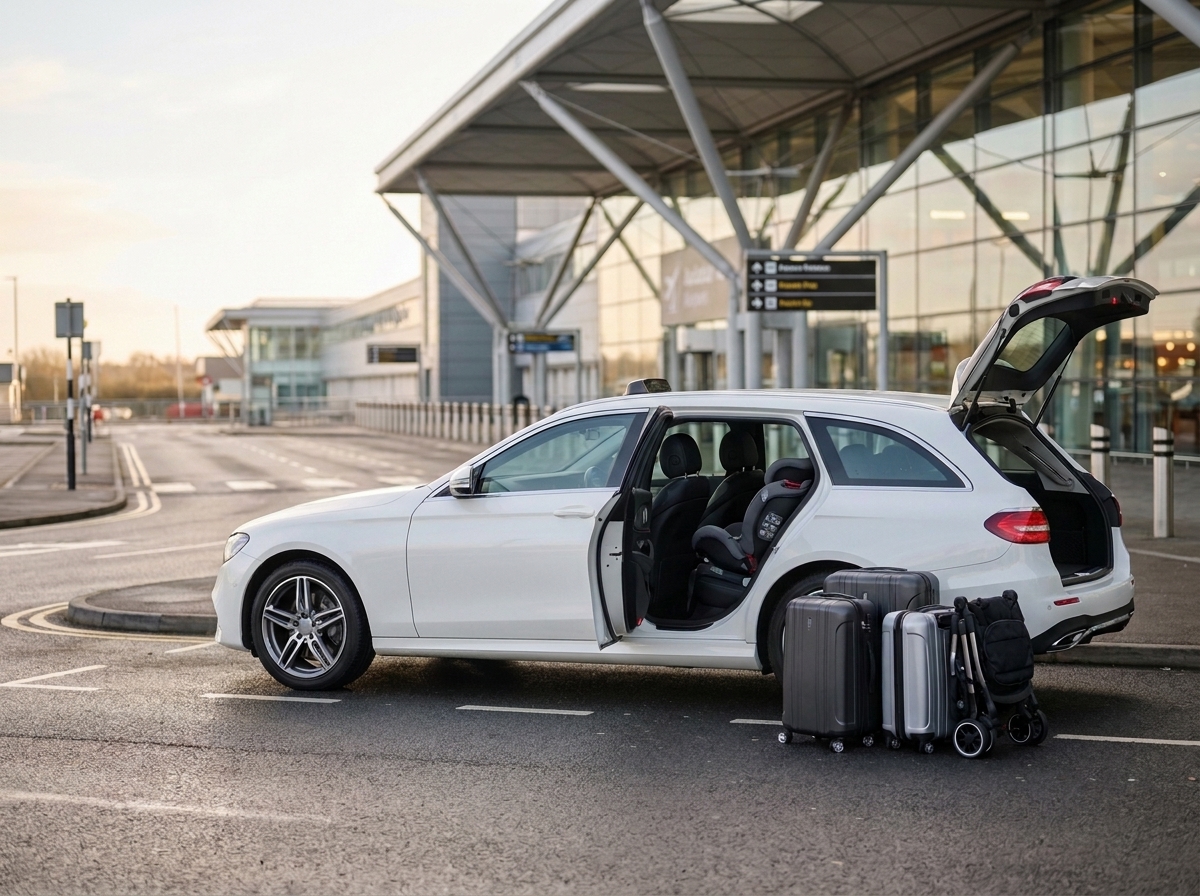
Manchester Airport Taxi With Child Seat: A Practical Guide for Families
Organising an airport journey with children involves more moving parts than most trips. There’s the pushchair, the suitcases, the hand luggage, the car seat question, and a departure time that often means leaving the house before anyone is properly awake.
The child seat part is the one worth sorting first, and the answer is simple: arrange it in advance and get it confirmed. A Manchester Airport taxi with child seat is something to discuss when you book, not something to raise with the driver on the doorstep at 4am.
Call A Car MCR has been running local journeys and airport transfers from Denton since 1970, and we take bookings by phone, through our online E-Booker and via our app. This guide covers what to ask, what information to have ready, what UK law actually says about children in taxis, and how to pick a vehicle that fits your family along with everything you’re taking with you.
Can You Book a Manchester Airport Taxi With a Child Seat?
Child seat arrangements vary between operators, and they can vary between vehicles within the same firm. That’s the honest position across the industry, and it’s why the safest approach is always to ask rather than assume.
Don’t assume a suitable restraint is already sitting in the boot of whichever car turns up. A seat that suits a six-month-old is not the same as one that suits a five-year-old, and a vehicle carrying one is not necessarily carrying the other.
Tell the booking team about every child travelling and the type of restraint required. The team can explain what arrangements are available for that particular journey.
This is also where a pre-booked private hire transfer differs from taking whatever’s next on a rank. With a pre-booked journey, there’s a conversation before travel day. Somebody knows a two-year-old is travelling, knows there’s a pushchair, and can allocate accordingly. Walking up to a rank gives you whatever is there, with no opportunity to plan.
Child seat requirements should be discussed and confirmed when booking rather than assumed on the day. If you take one thing from this guide, that’s it.
What Are the UK Child Seat Rules for Taxis?
Worth understanding properly, because the taxi rules are genuinely different from the rules in your own car.
The normal rule. Children must normally use a child car seat until they’re 12 years old or 135 centimetres tall, whichever comes first. Children over 12, or taller than 135cm, must wear a seat belt.
The taxi and minicab exception. If the driver doesn’t provide the correct child car seat, children can travel without one, but only on a rear seat. A child aged three or older must wear an adult seat belt. A child under three may travel without a seat belt.
That exception exists so families aren’t stranded. It is not a recommendation. A legal minimum and a safe choice are two different things, and a properly fitted, appropriate restraint remains the better option whenever one can be arranged. The exception is a fallback, not a plan.
One more rule worth knowing if a front seat is ever under discussion: front airbags must be deactivated before a rear-facing baby seat is fitted in a front seat.
Regulations change from time to time, so check the current position on GOV.UK before you travel. The relevant pages are child car seats: the law and when a child can travel without a car seat. The Highway Code rules for drivers cover seat belts and restraints more broadly. This guide is general information rather than legal advice.
Baby Seat, Toddler Seat or Booster: What Should You Request?
“A child seat, please” isn’t enough information, because the category matters.
Rear-facing infant carriers are for the youngest passengers. Under the weight-based approval system these cover roughly 0 to 13kg, and under the height-based system a seat must stay rear-facing until a child is over 15 months old.
Toddler and child seats come next, typically using a harness or safety shield, covering around 9 to 18kg under the weight-based groups.
High-backed boosters and booster cushions are for older children, broadly 15kg upwards, using the adult seat belt to restrain the child rather than a built-in harness.
Here’s the part that trips people up. Age on its own doesn’t reliably identify the right seat. UK-approved seats fall into two systems: height-based seats carrying an R129 label, and weight-based seats carrying an ECE R44 label. Which seat suits your child depends on the approval category, their height or weight, the manufacturer’s stated limits, and whether the seat is compatible with the vehicle it’s going into.
Two four-year-olds can need different restraints. That’s normal, and it’s exactly why the booking team may ask for more than a birthday.
So when you book, be ready to give each child’s age, approximate height and approximate weight. It isn’t nosiness. It’s the difference between arranging something suitable and arranging something that turns out not to fit.
Information to Provide When Booking
The more complete the picture, the better the vehicle allocation. Have this ready:
- Number of adults and number of children travelling
- Each child’s age
- Each child’s approximate height and weight
- The type and number of restraints needed
- Whether you’re bringing your own seat
- Number and size of suitcases
- Hand luggage
- Pushchair, pram or travel cot
- Anything unusually large or awkward
- Pickup address
- Terminal, or your flight number
- Whether you need the return journey as well
- A contact number that will be switched on
Giving all of this at the booking stage lets the operator allocate an appropriate vehicle and tell you clearly what can be arranged. It doesn’t guarantee that every request can be met on every journey, which is why confirmation matters more than assumption.
Bringing Your Own Child Seat
Plenty of families prefer their own seat. You know it, you’ve fitted it before, and you know it suits your child.
If that’s your plan, mention it when you book. If you plan to bring your own child seat, tell the operator in advance and confirm that it’s compatible with the allocated vehicle.
A few practical points:
Compatibility isn’t automatic. A seat needs a suitable belt configuration, or ISOFIX anchor points if that’s how it fits. Not every vehicle is set up the same way, so it’s worth checking rather than discovering it on the pavement.
Allow time for fitting. Installing a seat properly takes a few minutes, and those minutes need to exist in your schedule rather than being borrowed from your check-in buffer.
Follow the manufacturer’s instructions. They’re specific to that seat, and they take precedence over general advice.
Agree who fits it. Ask when you book so everyone knows before travel day.
Think about where the seat goes afterwards. Once you’ve been dropped at the terminal, the seat either flies with you or doesn’t come at all. If you’re hoping to leave it somewhere for the return trip, ask whether any such arrangement is possible rather than assuming one exists.
Choosing the Right Family Airport Vehicle
Here’s something that catches families out: a fitted child seat takes up more room than a child does.
Three adults fit across a back seat. Two adults and a bulky rear-facing infant carrier often don’t. So don’t pick your vehicle purely by counting heads, because the restraints change the maths.
Call A Car MCR operates standard cars, estate vehicles, executive options and 7 or 8 seater vehicles.
A standard car suits a small family with modest luggage and a straightforward seat arrangement.
An estate gives you more boot space, which matters once a pushchair is involved, since a pram plus a week’s suitcases fills a standard boot quickly.
A 7 or 8 seater is the sensible option for larger families, several children in seats, or anyone travelling with a travel cot alongside everything else. Our minibus hire covers the larger vehicles.
Tell the booking team what you’re carrying as well as who’s travelling. A family of four with two large cases and a pushchair needs a different vehicle from a family of four with hand luggage, even though the passenger count is identical.
Travelling With More Than One Child
Two children means two separate conversations, not one.
Siblings often need different restraint types. A one-year-old and a six-year-old need completely different equipment, so telling an operator “two child seats” doesn’t actually say what you need. Give each child’s details individually.
Seating space and belt compatibility both matter. Two seats need two suitable positions, with the right belt configuration in each.
There’s also a specific rule worth knowing. Where there isn’t room for a third child seat in the back, a child under three must travel in the front seat with the correct child car seat. Children aged three or older can sit in the back using an adult belt. If your family is in that territory, raise it at booking, because it affects which vehicle you need.
Then get it confirmed explicitly. Not “that should be fine,” but a clear confirmation of what’s been arranged for each child.
Planning the Journey to Manchester Airport
Book ahead, especially for early departures. Families need a specific vehicle rather than whatever’s free, and that’s easier to arrange with notice.
Build in loading time. Getting children, car seats, luggage and a pushchair into a vehicle takes longer than an adult with a cabin bag. Ten minutes you don’t need is better than ten minutes you don’t have.
Check your airline’s guidance on how early to arrive. Requirements differ between carriers and routes.
Give the correct terminal or your flight number. Manchester Airport’s terminal arrangements changed in recent years, so if your booking confirmation is old, check it against your airline’s current information.
Keep your phone to hand and make sure the number on the booking is the one you’ll actually have with you.
Read your confirmation properly. Check that the pickup time, address, vehicle and any restraint arrangements say what you expect them to say. Sorting a discrepancy the day before is easy. Sorting it on the doorstep is not.
For broader information on our airport work, see our Manchester Airport taxis page or our full airport transfers service. If you’re travelling from our home area, there’s a dedicated Denton to Manchester Airport page.
Returning From Manchester Airport With Children
The return leg needs arranging on its own terms. It isn’t automatically a mirror image of the outbound trip.
Give us your flight number. Our website states that we offer flight tracking, so the arrival can be monitored and the planned collection adjusted around it. Waiting arrangements should be confirmed with your booking.
Tell us about significant itinerary changes, particularly a new flight number, a different arrival airport, or a cancellation.
Confirm the pickup arrangement before you fly, so you know where you’re meeting the driver rather than working it out while shepherding tired children through arrivals.
Keep your phone switched on after landing.
Allow time for baggage reclaim, and for retrieving a pushchair, which sometimes comes off separately from the main belt.
Confirm the child seat arrangement for the return separately. This is the one families most often overlook. An arrangement made for the outbound journey does not automatically carry across to a different vehicle and a different driver two weeks later.
Family Airport Transfers From Tameside and East Manchester
We’re based in Denton and cover the surrounding communities, including Hyde, Audenshaw, Dukinfield, Stalybridge, Ashton-under-Lyne, Gorton and Droylsden.
For families, the value of a pre-booked door-to-terminal transfer is mostly about not having to move anything twice. No carrying a sleeping child from a car park to a tram, no folding a pushchair on a platform, no managing cases and children through a station. One vehicle, your front door, the terminal.
Add an early start to that and the difference is worth more than it looks on paper at 5am.
A Pre-Travel Checklist for Parents
- Child details supplied, including age, approximate height and weight
- Restraint arrangements confirmed for each child
- Own seat compatibility discussed, if you’re bringing one
- Vehicle size chosen with seats, luggage and pushchair in mind
- Luggage and pushchair declared
- Pickup time and address checked on your confirmation
- Terminal or flight number checked
- Return journey requirements confirmed, including the seat arrangement
- 0161 320 7117 saved in your phone
Frequently Asked Questions
Can I book a Manchester Airport taxi with a baby seat?
Tell the booking team when you book that an infant is travelling and what type of restraint you need. The team can explain what arrangements are available for that particular journey. Give the baby’s age and approximate weight, since that affects which seat is suitable.
Do children legally need a car seat in a UK taxi?
The normal rule is a child seat until 12 years old or 135cm tall, whichever comes first. In a licensed taxi or minicab, if the correct seat isn’t provided, a child may travel on a rear seat instead, wearing an adult belt if they’re three or over, or without a belt if under three. That exception is a legal fallback, not the safest option.
Can I bring my own child seat in a taxi?
Tell the operator in advance and confirm it’s compatible with the allocated vehicle, since belt configurations and ISOFIX availability vary. Allow time for fitting, follow the manufacturer’s instructions, and agree beforehand who will install it.
What information should I provide when requesting a child seat?
Each child’s age, approximate height and weight, and the type of restraint needed. Also mention pushchairs, luggage and total passenger numbers so the right vehicle can be allocated.
Can an airport taxi accommodate two child seats?
It depends on the vehicle, the restraint types and the belt positions available. Give each child’s details separately rather than asking for “two child seats,” and ask the booking team to confirm what can be arranged for your journey.
Should I count a baby as a passenger when booking?
Yes. A baby in a carrier occupies a seat position, and the carrier itself takes up more room than the baby does. Always include infants in your passenger count.
Which taxi is suitable for a family with a pushchair and suitcases?
Usually an estate or a larger vehicle, depending on how much you’re carrying. Passenger count alone isn’t a reliable guide, so describe your luggage and pushchair when booking.
Should I confirm a child seat again for my return journey?
Yes. Confirm the return arrangement separately rather than assuming the outbound arrangement carries over, since it’s a different vehicle on a different day.
How far in advance should I arrange a family airport transfer?
As early as you reasonably can, particularly for early departures and school holidays. Specific vehicles and restraint arrangements are easier to organise with notice.
What happens if the required child seat cannot be confirmed?
Ask the booking team what the options are for your journey. You may be able to bring your own seat, or a different vehicle may suit better. Call 0161 320 7117 and discuss it before you travel rather than leaving it to the day.
Booking Your Family Airport Transfer
The whole thing comes down to one habit: say more at the booking stage than feels necessary. Every child’s details, every case, the pushchair, the travel cot, the return leg. It takes an extra two minutes on the phone and it removes almost everything that can go wrong on the morning.
To arrange a Manchester Airport taxi with child seat requirements, call 0161 320 7117, use our online E-Booker, or book through the Call A Car app. Tell us who’s travelling, what restraints you need and what you’re bringing, and get it confirmed before you travel.


